



Construction Site Sensory Bin



Sensory bins provide children with opportunities to explore textures, practice fine motor skills, and use their imaginations. A construction site sensory bin can also encourage communication, pretend play, problem-solving, and following directions.
Materials Needed
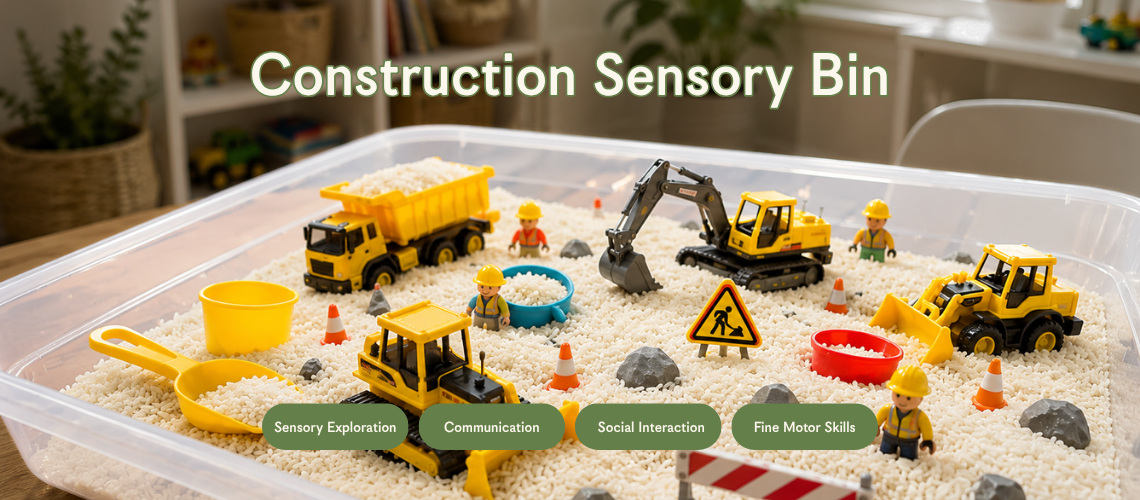
Choose a sensory filler such as:
• Dry rice
• Dry pasta
• Dry beans
• Shredded paper
You will also need some of these toys:
• Small toy cars or construction vehicles
• Plastic cups, spoons, or scoops
• Toy people, animals, or signs
Always supervise sensory play closely. Avoid small items for children who may place materials in their mouths, and choose a filler that is safe for your child.
Instructions
Pour the sensory filler into a shallow bin or container. Then, add toy trucks, cups, scoops, and other items. You can create small piles of material for the trucks to move or use blocks as buildings, roads, and walls.
Explore the Materials
Before beginning, explore the materials together. Try asking:
• “What do you see in the bin?”
• “Which truck do you want?”
• “How does the rice feel?”
• “Is it soft, rough, smooth, or bumpy?”
• “Which tool should we use first?”
• “Which container is bigger?”
If open-ended questions are difficult, you can offer choices, like:
• “Do you want the dump truck or bulldozer?”
• “Should we build a road or a tower?”
• “Do you want to scoop or pour?”
• “Should the blocks go here or there?”
Practice Following Directions
Begin with simple one-step directions, like:
• “Put the rock in the truck.”
• “Fill the blue cup.”
• “Push the bulldozer.”
• “Give me the block.”
• “Park the truck.”
As your child becomes comfortable, try two-step directions, like:
• “Pick up the rock and put it in the truck.”
• “Fill the cup and pour it into the box.”
• “Find the yellow truck and park it by the blocks.”
• “Build a tower and knock it down.”
Keep directions short and give your child time to respond before repeating or offering help.
Practice Taking Turns
Use the trucks and tools to practice taking turns in a fun, low-stakes environment. You might say:
• “My turn to scoop. Then your turn.”
• “You have the truck. I have the bulldozer.”
• “First I pour, then you pour.”
• “Can I have a turn?”
• “Tell me when you are finished.”
Using a visual timer or a short count can help make turn-taking more predictable.
Add Pretend-Play Problems
Simple pretend-play situations can encourage conversation and help your child practice problem solving. Try scenarios such as:
• A truck is stuck.
• A road is blocked.
• A building falls down.
• The dump truck is full.
• A worker needs help.
• A truck needs to wait for its turn.
To spark pretend play, you can ask:
• “What happened?”
• “How can we help?”
• “Which truck should we use?”
• “What should happen next?”
• “Who needs a turn?”
• “Where can the truck go?”
• “What could we try?”
There is no single correct answer. The goal is to encourage your child to think, communicate, and participate in the story.
Sensory play does not need to follow a strict lesson plan. Let your child explore, repeat favorite actions, and communicate in the way that works best for them. The shared play and conversation are just as important as the construction site itself.