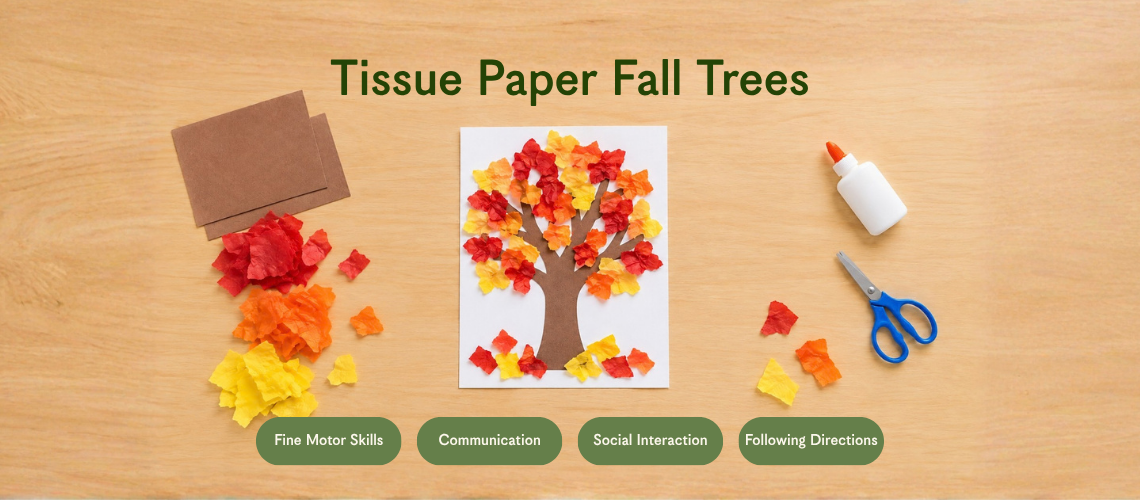




Tissue Paper Fall Trees



This autumn craft helps children develop fine motor skills while expressing themselves creatively and getting in the fall spirit!
Materials Needed
• White paper
• Brown Construction Paper
• Red, orange, and yellow tissue paper
• Glue
• Scissors
Instructions
Step 1: Create the tree
Cut a tree trunk out from the brown construction paper. Then, glue it onto the paper.
Step 2: Prepare the leaves
Tear the tissue paper into small pieces. These will be your leaves.
Step 3: Glue the leaves
Glue pieces of tissue paper onto the branches, filling in the leaves on your tree.
Fine Motor Skills
Pinching, tearing, crumpling, and placing tissue paper helps strengthen the small muscles of the hands and fingers. If your child is learning to use scissors, you can encourage them to use the scissors to cut out the tree trunk and cut the tissue paper into small pieces. If they are not quite ready for scissors, encourage them to help you tear the paper into small pieces. Tearing the paper, picking up the small pieces, and gluing those piece onto the paper can all help build those fine motor skills!
Communication
Crafts create natural opportunities to model words, offer choices, make comments, and encourage children to communicate what they want. Instead of asking questions right away, you might start a conversation by simply describing what your child is doing:
• “You have so many orange leaves!”
• “That piece is really crinkly.”
• “Your leaf is falling down, down, down!”
• “I like how you put some leaves on the ground."
• “I love to stomp on crunchy leaves!"
These types of statements can open them up to a conversation without putting pressure on them to respond right away or in a certain way.
Following Directions
As you work on creating your tree, you can practice giving simple instructions for them to follow. You might start with simple one-step directions such as:
• “Get a yellow leaf.”
• “Put it on the tree.”
• "Open the glue."
If your child has mastered one-step directions, you can expand them to include multiple steps or more complicated instruction, like:
• "Get a leaf and glue it onto the tree."
• "Cut up some orange paper and put it in a pile."
• "Put the leaf under the tree."
Giving instructions in this fun, creative setting can help your child practice following directions in a calm, low-pressure situation. Building this skill will help them as they learn to follow directions in other settings, like when they are getting ready in the morning or on a family outing.
Creativity and Choice-Making
The most important part of any craft is to have fun and get creative! Let your child decide which colors to use and where to place their leaves. Giving children choices during play encourages independence and allows them to take an active role in the activity. When they are done, you can hang their masterpiece up on the wall or fridge to celebrate their creativity and hard work!
Follow your child’s lead and focus on the experience of creating together. Simple activities like this can become opportunities to practice communication, build new skills, and enjoy learning through play.